

Menstrual Equity in Maryland Why Period Care Matters and How Communities Can Help
- Leanne Listman
- Aug 3
- 8 min read

A period should never keep someone home from school, away from work, or isolated from daily life. Yet for many people in Maryland, the cost and availability of pads, tampons, liners, cups, and other basic supplies can turn a normal body function into a monthly crisis.
Menstrual equity is the idea that everyone who menstruates should have safe, affordable, and stigma-free access to the products, facilities, education, and support they need. It is practical, public, and deeply local. It shows up in school bathrooms, shelter supply closets, college campuses, detention facilities, food pantries, and neighborhood donation drives.
In Maryland, the need is real. Baltimore City, Annapolis, and communities across the state face different challenges, but the same truth connects them: period care is health care, and no one should have to choose between food, transportation, rent, and menstrual products.

What menstrual equity means
Menstrual equity is about more than free products, though product access is a key part of it. The movement works to remove the barriers that make menstruation harder, more expensive, more shameful, or less safe than it should be.
That includes:
Affordable access
Pads, tampons, liners, cups, period underwear, and pain relief should not be treated as optional extras.
Reliable availability
Products need to be present where people actually are, including schools, shelters, libraries, community centers, workplaces, and public restrooms.
Accurate education
Young people and adults need clear, stigma-free information about periods, hygiene, and health.
Safe facilities
Clean bathrooms, running water, disposal bins, and privacy matter.
Respect for all people who menstruate
Menstrual equity includes girls, women, transgender men, nonbinary people, people with disabilities, people experiencing homelessness, incarcerated people, and anyone else who menstruates.
At its core, menstrual equity asks a simple question: if menstruation is a normal part of life, why are so many people left to manage it without basic support?
Menstrual equity and period poverty are connected but not the same
People often use the terms menstrual equity and period poverty together. They are closely linked, but they do not mean the exact same thing.
Period poverty describes the problem. It refers to the lack of access to menstrual products, hygiene facilities, education, or support due to financial hardship or other barriers.
Menstrual equity describes the goal. It is the broader movement to make period care fair, accessible, and free from stigma.
Period poverty focuses on what people lack.
It may mean someone cannot afford pads this month.
It often shows up as an urgent need.
Menstrual equity focuses on what systems should provide.
It asks why essential products are not available in schools, shelters, and public spaces.
It works toward long-term change through policy, education, and community support.
Both matter. Period poverty demands immediate help. Menstrual equity pushes communities to build systems where that emergency is less likely to happen in the first place.
What the statistics show in Maryland, Baltimore City, and Annapolis
Reliable local data on period poverty is still limited. Many public surveys track poverty, housing, school attendance, and health, but they do not always ask whether someone missed class, work, or daily activities because they lacked period supplies.
That data gap is part of the problem. If public agencies do not measure menstrual need, communities often underestimate it.
Still, several local indicators show why menstrual equity in Maryland matters.
Area | What the numbers suggest |
Maryland | Maryland has more than 6 million residents. Recent Census estimates place the state poverty rate around 9% to 10%, which means hundreds of thousands of residents live with tight monthly budgets. Even a small recurring expense can become a barrier when food, rent, transportation, and utilities compete for the same dollars. |
Baltimore City | Baltimore City has a much higher poverty rate than the state overall, often estimated around one in five residents. For students, families, people without stable housing, and low-wage workers, menstrual products can be difficult to buy consistently. |
Annapolis | Annapolis is often associated with government, tourism, and waterfront neighborhoods, but many residents still face housing pressure and income insecurity. Recent estimates often place the poverty rate roughly around 10% or higher, depending on the year and source. Local need can be less visible, especially in smaller cities where hardship sits close to wealth. |
The cost of period products also adds up. A box of tampons or pads can cost several dollars, and many people need more than one type of product each cycle. People with heavier periods, irregular bleeding, medical conditions, postpartum needs, or limited laundry access may spend more.
For a household already stretched thin, the question becomes painful and practical: buy period products, or buy something else that also cannot wait?

What the menstrual equity movement addresses
Menstrual equity touches education, health, economic stability, and dignity. The movement addresses several barriers at once because period need rarely has one cause.
Product access
The most visible barrier is the simplest one: people need products and cannot always get them.
Food assistance programs do not always cover menstrual products. Many community aid programs focus on food, diapers, or clothing, while period supplies are overlooked or understocked. People may rely on toilet paper, paper towels, old cloth, or products worn for too long, which can be uncomfortable and unsafe.
School attendance and participation
Students who do not have supplies may miss class, leave early, avoid sports, skip after-school activities, or feel anxious throughout the day. A student should not have to ask multiple adults for a pad, bleed through clothing, or sit in class worried about a basic bodily need.
Schools can make a major difference by placing free products in restrooms, not only in the nurse’s office. When products are easy to get, students lose less class time and face less embarrassment.
Workplace stability
Hourly workers may not have the flexibility to leave a shift to buy products. People working multiple jobs may not have easy restroom access, storage space, or extra cash before payday. Period poverty can affect punctuality, comfort, confidence, and income.
Housing insecurity
People experiencing homelessness or unstable housing face added challenges. They may not have steady access to bathrooms, laundry, disposal, or storage. Period products are also hard to carry in bulk. A person living outside, in a shelter, or moving between homes needs products that are accessible, portable, and available without judgment.
Stigma and silence
Many people are taught to hide periods, speak about them quietly, or treat them as embarrassing. That silence makes it harder to ask for help, harder to advocate for funding, and harder to recognize period care as a public health need.
Menstrual equity challenges that silence. It says periods are normal, and meeting this need should be normal too.
Why menstrual equity matters
Menstrual equity matters because period care affects daily life in ways that are easy to overlook if products are always available.
When someone has the supplies they need, they can:
Attend school without fear of bleeding through clothes
Go to work and stay through a full shift
Participate in sports, worship, appointments, and community life
Manage their health with comfort and dignity
Spend limited money on food, rent, gas, prescriptions, or child care
The impact is especially clear for young people. A student who has reliable access to products can focus on learning instead of worrying about an emergency. A school that stocks bathrooms sends a quiet but powerful message: bodies are not shameful, and basic needs belong in public planning.
The same is true in shelters, libraries, reentry programs, food pantries, colleges, and community centers. Period products are small items, but they can remove a large barrier.
The Period Pantry mission
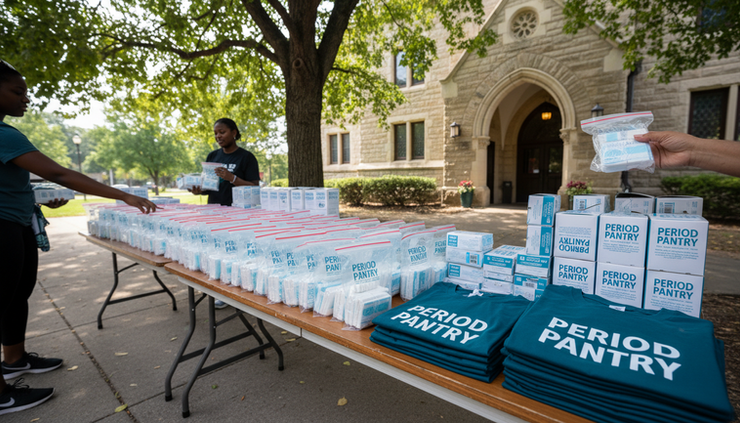
The Period Pantry mission is rooted in a direct and compassionate idea: period care should be easy to find when someone needs it.
A period pantry model brings menstrual products into community spaces where people already seek help or connection. Instead of treating period products as rare specialty donations, it places them alongside other basic needs.
That can mean collecting and distributing:
Pads in different sizes
Tampons with varied absorbency levels
Liners
Menstrual cups
Period underwear
Wipes where appropriate
Individual care kits
Educational materials
The mission is not only to hand out products. It is also to reduce shame, raise awareness, and help communities see menstrual care as part of basic public support.
A well-stocked pantry says, without making anyone explain themselves, “Take what you need.”
What local action can do
Local action is powerful because period need is immediate. A statewide policy can help, but a stocked basket in a school restroom can help someone today.
Communities in Maryland can support menstrual equity in practical ways.
Schools can stock products where students need them
Products should be available in restrooms, not locked away or limited to a single office. Students should not need to explain their cycle to get a pad.
Good school access includes:
Free products in bathrooms
Supplies in multiple sizes
Disposal bins in stalls
Clear restocking plans
Inclusive access for all students who menstruate
Community organizations can include period products in basic aid
Food pantries, mutual aid groups, libraries, youth centers, shelters, and health clinics can make menstrual products part of regular distribution. The key is consistency. One-time drives help, but monthly access matters more.
Local governments can treat period care as a public need
City and county leaders can fund product access in public buildings, support school supply programs, and include menstrual products in emergency response planning. Periods continue during storms, housing crises, displacement, and economic downturns.
Neighbors can normalize giving
Donation drives work best when they ask for specific items and explain the need clearly. People often donate what they personally use, but pantries need variety. Heavy-flow pads, overnight products, unscented items, and individually wrapped products are often especially useful.
Local action also builds trust. When people see period products in familiar spaces, they are more likely to take what they need and tell someone else where to find help.
Growing nationally and building a bigger vision
The menstrual equity movement is growing across the United States. Advocates have pushed for free products in schools, shelters, prisons, jails, colleges, and public buildings. Many states have also revisited taxes on menstrual products, recognizing that period supplies are necessities, not luxury goods.
The bigger vision is simple and ambitious: period care should be treated like toilet paper, soap, and handwashing supplies. It should be expected in public restrooms and basic support programs.
A national movement can help by:
Setting stronger policy standards
Sharing successful local models
Funding research and data collection
Supporting school-based access
Protecting access for incarcerated and unhoused people
Reducing stigma through public education
Maryland can be part of that larger shift while still focusing on local realities in Baltimore City, Annapolis, and communities across the state. National change grows stronger when local groups prove what works.
How people can support the movement
Supporting menstrual equity does not require a large platform or a formal role. It starts with treating period products as basic needs and helping make them available.
Here are practical ways to help:
Donate products
Choose unopened, unscented products when possible. Include a range of pads, tampons, liners, and sizes.
Give funds
Money allows organizers to buy exactly what is needed, especially bulk products or under-donated items.
Host a collection drive
Schools, faith communities, book clubs, gyms, neighborhood groups, and workplaces can collect supplies for local distribution partners.
Ask better questions
If a school, shelter, library, or community center serves the public, ask whether period products are available and how often they are restocked.
Support policy change
Contact local and state representatives about funding menstrual products in schools, shelters, correctional facilities, and public buildings.
Talk about periods without shame
Stigma fades when people speak plainly. Periods are normal. Needing help is normal. Asking for better access is reasonable.
The most useful support is steady support. Periods happen every month, so product access needs to be reliable every month.

A future where period care is never out of reach
A fair future is one where no student has to miss class because they could not afford pads. No worker has to choose between tampons and bus fare. No person in a shelter has to ask again and again for a basic hygiene product. No one has to feel ashamed for having a body that menstruates.
Menstrual equity is not a side issue. It is tied to health, education, income, dignity, and full participation in community life.
The work in Maryland, from Baltimore City to Annapolis and beyond, can help set a clear standard: period products belong wherever basic needs are met. Through pantries, schools, local policy, donations, and honest conversation, communities can close the gap between need and access.
A future where period care is never out of reach is possible. It begins with stocked shelves, shared responsibility, and the belief that dignity should never depend on someone’s ability to pay for a pad.
To display the Widget on your site, open Blogs Products Upsell Settings Panel, then open the Dashboard & add Products to your Blog Posts. Within the Editor you will only see a preview of the Widget, the associated Products for this Post will display on your Live Site.
Start your 14 days Free Trial to activate products for more than one post.
icon above or open Settings panel.
Please click on the

Comments